Why I Stress Test Business Models Before Talking to Customers
An advisor once killed my business model in five minutes, nine months too late. Now I run that conversation first, across seven dimensions, before any customer hears the idea.

First published as episode 2 of the Building LEANSpark series. This is the notebook version; the episode has the video.
Last time I ended with a promise: the business model stress-test prototype that convinced me an AI co-founder could work is where I would start. So here it is: what a stress test is, why I run one before any customer ever hears the idea, and what happened when I pointed the prototype at my own canvas.
The five minutes that cost me nine months
Back in 2009, I was building CloudFire, a photo and video sharing product for busy parents. By all accounts I was doing everything by the book. I lined up customer interviews, got enough people to validate the problem, built an MVP, and even got paying customers.
Then an advisor destroyed my business model in five minutes. Using a handful of key metrics, he showed me the model was fundamentally broken. The bad news was painful, but what bothered me more was the arithmetic: nine months spent pursuing a flawed model that a five-minute conversation could have caught on day one.
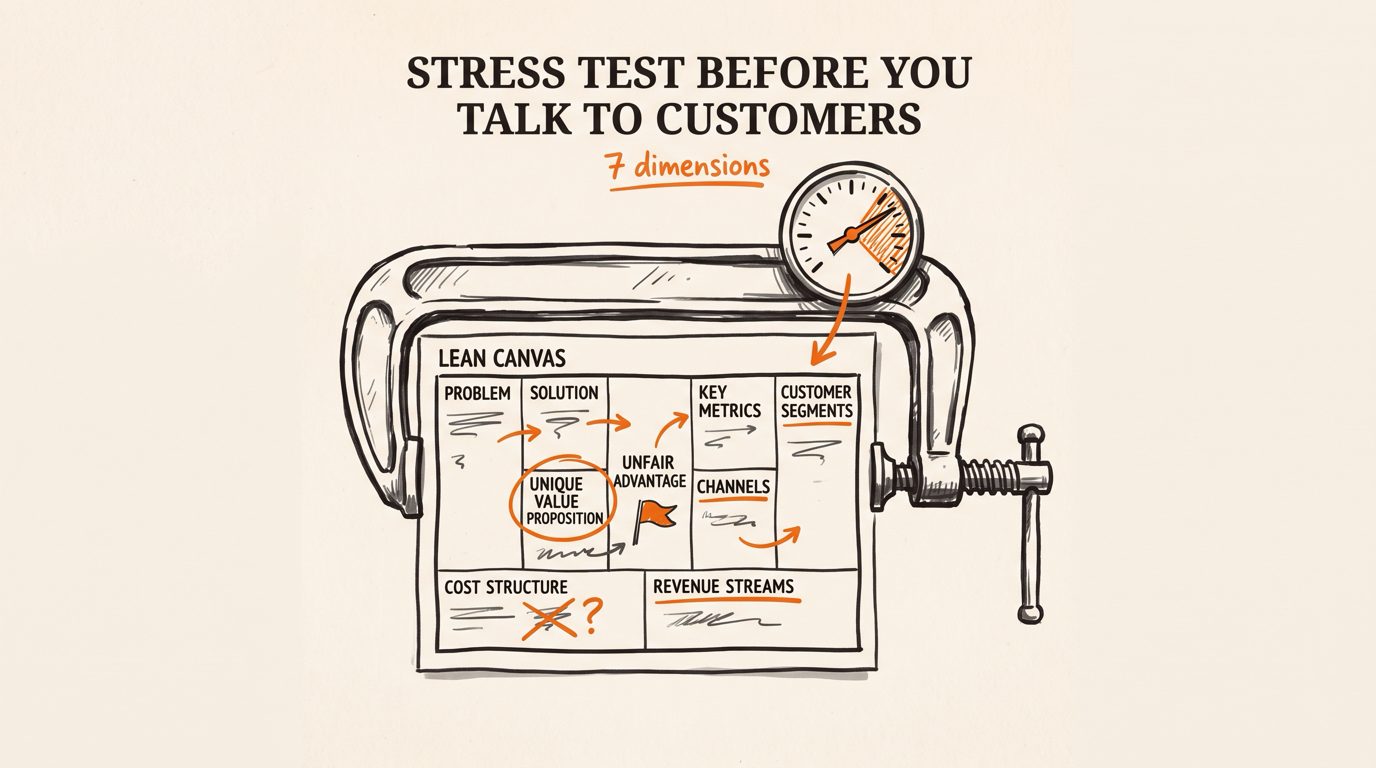
That five-minute conversation became the first of seven foundational stress tests I now apply to every new idea: mission, clarity, desirability, viability, feasibility, defensibility, and timing. Think of them as business model simulations. Each one applies stress along a single dimension and exposes flaws you can fix before investing real resources.
You cannot test a vague idea.
Most founders rush to validate with customers. I understand the instinct; getting out of the building is the right religion. But if your model has obvious cracks, you will spend months chasing signals that lead nowhere.
Pointing the agent at my own canvas
The lab for this series is LEANSpark, and true to form, the first canvas through the stress tests was its own; the honest caveat is that an agent’s verdict is only as good as the assumptions I feed it, and these were mine. None of this requires the tool either: the seven questions work on a whiteboard, and the viability math fits on a napkin.
What makes an agent different from chatting with an LLM is the loop underneath, the same Plan-Do-Check-Act cycle W. Edwards Deming taught manufacturers. The agent reviews the canvas (plan), runs a stress test (do), scores the result against success criteria (check), and recommends what to fix next (act). No echo chamber, because the score is anchored to criteria set before the run.
The first finding was embarrassing. “Your canvas contains 3 distinct business models mixed together.” It identified a founder model, a B2B coach platform, and an investor segment, all sharing one canvas. It was right. I had been keeping placeholders that needed to be split into focused variants. Most starting canvases have this disease; they are big idea canvases. The agent generated three variant canvases in parallel, recommended starting with the founder canvas (the most developed), and scored its clarity at 13 out of 15.
The test that made me 10x my goal
The most consequential dimension was viability. I supplied my minimum success criteria, $1M ARR, plus rough pricing assumptions, and the agent ran a Fermi estimation (the back-of-the-envelope discipline named for the physicist Enrico Fermi) to check whether my target market was large enough to get there.
The math worked for $1M. But running the estimate revealed something bigger. Given tens of millions of startups globally, $1M was a timid bar for this idea. I raised my minimum success criteria 10x, to $10M ARR: 10,000 customers paying $1,000 per year. Ambitious, but feasible given the market size and a growing YouTube channel to draw on.
One pricing note from the same test, since I have been running pricing experiments in public since 2010: anchor value-based, against the existing alternatives your customers already pay for, not cost-based against your token costs. With AI products the temptation to price off compute is strong. It is also a trap.
What a stress test is not
A stress test does not replace customer validation. Nothing above proves that a single founder will pay $1,000 a year; only customers can do that, and that test comes next. What a stress test does is prepare you for validation by making the model focused enough to test.
Two hours of stress testing against nine months on a broken model. That is the trade, and I will take it every time.
You cannot test a vague idea. I now have a focused one, a $10M bar, and math that says it can work. Next episode: how I turn this validated canvas into a 90-day plan, because everything on that canvas is still a guess, and time is the one startup resource that only moves in one direction.
-Ash
P.S. If you want the video version with the full stress-test run on my canvas, it is in episode 2 of Building LEANSpark.