Why I Waited Three Years to Build an AI Co-Founder
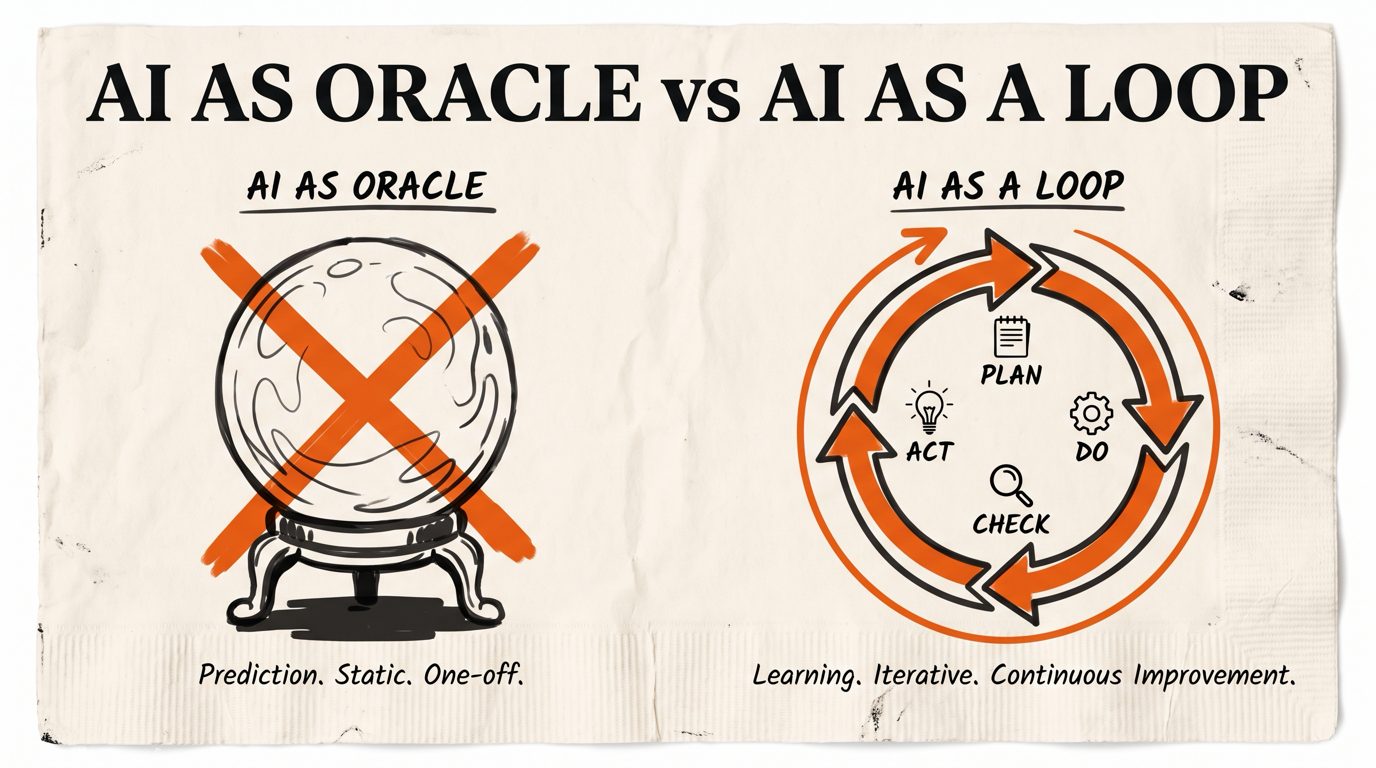
ChatGPT launched in November 2022 and I spent three years saying no. What changed my mind was not a better oracle. It was a loop.

First published as episode 1 of the Building LEANSpark series. This is the notebook version; the episode has the video.
When ChatGPT launched in November 2022, the world went crazy. Within weeks there were services generating startup ideas, Lean Canvases, landing pages, even starting code. Smart people were declaring the end of customer research.
I spent the next three years saying no. This post is about what finally changed my mind, because the answer surprised me, and it was not a better model.
The echo chamber problem
My skepticism was specific. An LLM cannot come up with a successful startup idea from a one-shot prompt. Going from 0 to 1 requires non-linear thinking, and that is not how these models work. Challenge an LLM’s answer with a different point of view and it does not hold its ground. It changes its answer to match yours.
That is not breakthrough thinking. That is an echo chamber with good grammar.
So while everyone chased generative AI (asking machines for answers), I went the other way: predictive AI. Not oracles, but tools that speed up work that is hard for humans and simple for machines. The clearest case I knew from my own practice was customer interviews: I had spent a decade teaching founders to collect them, and watched most drown in the analysis afterward. Finding the forces patterns across twenty transcripts (the lens I borrowed from Bob Moesta’s jobs-to-be-done work) takes a person days and a machine minutes.
We built Customer Forces AI in early 2023 to do exactly that. It worked, it became a foundational tool in our demand validation playbook, and it kept my answer at no. AI as an analyst, yes. AI as a founder, no.
What the coding agents changed
Then in early 2025, vibe coding agents changed the question. Lovable, Replit, and Claude Code could build real working software autonomously, and the reason they could was not a smarter model. It was a loop: plan, code, test, repeat, with the agent measuring its own output against a goal and correcting course.
Credit where it is due: watching those tools work was the trigger. The insight was not theirs alone; it is the same Plan-Do-Check-Act cycle that runs through everything I teach. But seeing it automated end to end raised a question I could not put down. My Continuous Innovation Framework is already a loop: model, prioritize, test. If an agent can run a coding loop, could an agent run a validation loop?
The opportunity was never asking AI for answers. It is using AI to run better experiments, faster.
Three prototypes, two funerals
I have to be honest about the middle part, because it was not a straight line. We ran three parallel proof-of-concept approaches through the summer of 2025.
The first two were deterministic workflows: hand-wired pipelines that marched a business model through fixed steps. Both died. They were too rigid for the messy, branching reality of an actual validation journey, and every edge case meant more wiring. Weeks of work, discarded. That failure had a familiar shape: it was me trying to script judgment instead of staging it.
The third approach was the agentic loop. Give the agent simple tools, a goal, and a way to measure success, then let it figure out the path. I prototyped business model stress tests and watched the agent take a Lean Canvas, decide which tests to run, score them, and move to the next one without being told. The dozens of validation recipes I have cataloged over the years stopped being course content and became tools the loop could pick up.
That was the moment the risk flipped. I went from “this cannot work” to roughly 80% confident we could build it.
So naturally, I did not build it
Here is where the old playbook kicked in. 80% confidence in feasibility says nothing about demand. So in October I launched a Demo-Sell-Build campaign: demo the working prototype, sell the founding memberships, and only then build the product out.
LEANSpark is the specimen in this experiment, and I am deliberately its first power user, running LEANSpark’s own business model through LEANSpark. I have used this meta-recursive move with every product I have shipped, from my first book onward, because dogfooding surfaces every friction point before a customer hits it. Whether anyone besides me will pay for an AI co-founder is exactly what the campaign is designed to find out, and none of it requires the tool: model, prioritize, test works the same on paper.
Three years of no, one summer of prototypes, two funerals, one loop that worked.
I will report what the campaign teaches, numbers included, in the next episode. The stress-test prototype that convinced me is where I will start.
-Ash
P.S. If you want the video version with the prototype demos, it is in episode 1 of Building LEANSpark. Fifteen minutes.