Why I Plan in 90-Day Cycles
Your 3-year goal is too far away to drive daily decisions, and your task list does not add up to a strategy. The missing middle between them is a 90-day cycle.

First published as episode 3 of the Building LEANSpark series. This is the notebook version; the episode has the video.
Last time the stress tests left me with a validation-ready canvas and a $10M ARR bar. This is exactly where founders get tripped up, and I include past versions of myself in that group. Everything on a Lean Canvas is a guess that needs testing, and the instinct is to test all of it at once. Resources get spread thin. Weeks turn into months with slow progress on everything.
Of all the resources in a startup, time is the scarcest. Money and people fluctuate up and down. Time only moves in one direction.
The missing middle
Your 3-year goal is too far out to drive daily decisions. Your daily tasks, without structure, fail to connect to that big goal. Most founders live at one of those two altitudes and lose the plot in between.
90-day cycles bridge the gap. They are long enough to make meaningful traction progress; you can actually reach 10, 50, or even 100 customers if you stay focused. They are short enough to maintain urgency. And they force prioritization, because you simply cannot do everything in 90 days.
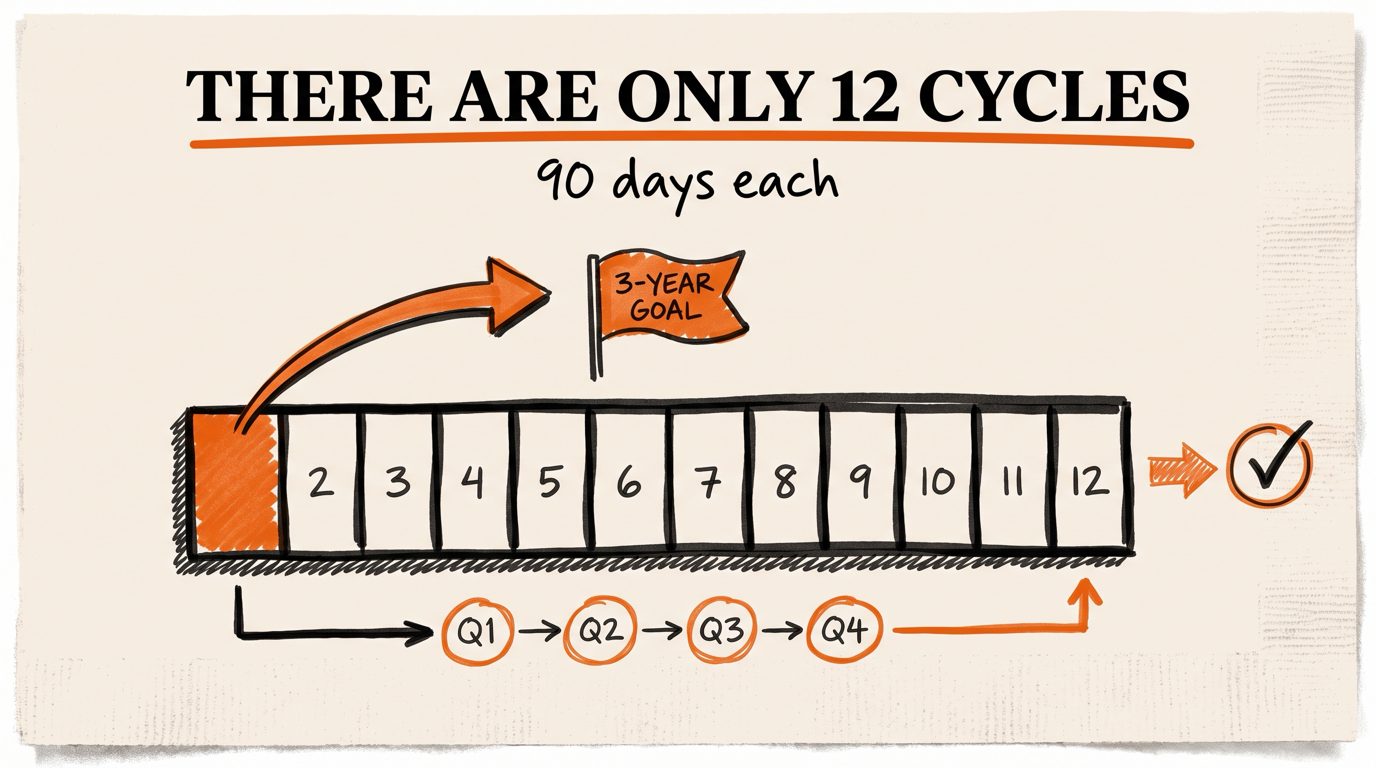
There are only twelve 90-day cycles between you and your 3-year goal.
Twelve. The first time I did that arithmetic, it permanently changed how I treat a quarter.
Each cycle is driven by one traction milestone from the roadmap, because traction is the goal and everything else is a distraction. The milestone drives campaigns: sequences of experiments designed to hit the goal. Campaigns break into 2-week sprints, long enough to make real progress on an experiment, short enough to hold focus. Goal, campaign, sprint, experiment, task. Underneath it all runs W. Edwards Deming’s Plan-Do-Check-Act cycle, nested at three time horizons: the 3-year startup loop, the 90-day loop, and the 2-week loop, each one a checkpoint that you are still heading the right way.
My first 90-day goal for this business: starting 200 paid trials.
What the agent planned
When I asked the agent to design my 90-day cycle, I half expected a generic template. Instead it analyzed the business model, the traction roadmap, and current metrics to identify the primary constraint: acquisition, since we were starting from zero customers. It matched that constraint to our demand validation playbook and suggested a Mafia Offer campaign (yes, an offer founders cannot refuse). Then it broke the cycle into a planning phase, five core sprints running from problem discovery through offer delivery, and a closing 3P review: pivot, persevere, or pause. Eric Ries framed the pivot-or-persevere decision; I add pause as the third honest option, because sometimes the right move is neither.
The plan was intentionally high-level. Field Marshal Moltke observed that no plan survives first contact with the enemy, and startup plans survive contact with reality no better. Only when I accepted the plan and started sprint 1 did the experiment-level loop kick in: designing the first broad-match problem discovery interviews, building prospecting criteria, drafting an interview script, and pulling prospecting recipes from the validation cookbook.
Where the timebox drew blood
Here is the confession for this episode. My original build plan called for 7 specialized agents. The 90-day constraint forced us down to 3 that could actually ship. Cutting 4 agents from my own product plan hurt, and it was exactly the medicine the cycle is designed to administer. Over-planning is a form of waste: keep the 90-day plan strategic, and only detail experiments when a sprint starts.
LEANSpark is both the lab and the specimen here: the agent that planned this cycle is the same product whose scope the cycle just cut, and whether its constraint diagnosis was right is what the next 90 days will test. You do not need it to run the play; a wall calendar, one traction goal, and the discipline to say no fit on a single sheet of paper.
The early scoreboard
We are a few weeks into execution, and the campaign has produced 142 founding members and $3,550 in monthly recurring revenue. Against a first-cycle goal of 200 paid trials, that is a strong early signal. I am holding the celebration until the 3P review.
Right action, right time. There are only twelve 90-day cycles between you and your 3-year goal; spend this one on the constraint that actually matters. Next episode: the campaign behind those numbers, Demo-Sell-Build, and how you sell a product that is not built yet.
-Ash
P.S. If you want the video version with the full cycle plan, it is in episode 3 of Building LEANSpark.