Why I Stopped Building an AI Coaching Tool
Two months of problem discovery interviews revealed that founders were not starving for frameworks. They were drowning in tools with amnesia.

First published as episode 5 of the Building LEANSpark series. This is the notebook version; the episode has the video.
Last time I shared how the Demo-Sell-Build campaign crossed 209 customers, and I mentioned that every concierge review doubled as a disguised problem discovery interview. This episode is about what two months of those interviews revealed, because one finding changed the product.
Throughout October and November, the entry point was always the same. A founder signed up for a canvas assessment, I walked them through it personally, and at the end I asked if I could interview them separately about how they were currently validating their idea.
Four forces, one broad question
I used the Customer Forces framework, a lens I adapted from Bob Moesta’s jobs-to-be-done work. Innovation is about causing a switch from an old way to a new way, and every switch is shaped by four forces: Push (what drives someone to seek a new solution), Pull (what attracts them toward a specific one), Inertia (what keeps them stuck with the current approach), and Friction (what creates anxiety about switching).
The framing was deliberately broad, in the spirit of Rob Fitzpatrick’s Mom Test: talk about their life, not your idea. I did not ask “Tell me how you use AI.” I asked “Tell me how you are currently validating your idea.” What occupies their attention, what tools they use, how they use them. Broad-match interviews keep you out of the local maxima trap of only talking to AI enthusiasts and missing the bigger market.
Three findings
First, every founder I spoke with had already tried AI tools somewhere in their startup process. That is a positioning fact: if everyone is already using AI, then AI tools are the true competition to anchor against, not the old manual ways.
Second, the use cases were scattered: research with Perplexity, brainstorming with Claude Projects, interview analysis, coding, marketing campaigns. No single dominant use case.
The third finding was the breakthrough: the context switching tax. Founders context-switch constantly between building, talking to customers, fundraising, managing teams, and learning new frameworks. On top of all that, they have to manage the context window of their AI tools. Every conversation starts from scratch. They are constantly re-explaining who they are, what their startup does, what they have already tried, and what they are trying to do now.
The Memento problem
I started calling this the Memento problem, after the movie where the protagonist wakes up every day with no short-term memory, relying on notes and tattoos to remember who he is. That is what using most AI tools feels like for a founder: constant re-orientation, no memory of past sessions.
The counterpoint is The Matrix, where characters download programs just in time and instantly learn new skills. That is what good AI should feel like. Load massive context in seconds, remember everything, learn new skills on the fly.
Founders do not struggle with a shortage of things to do. They struggle with focusing on the right things, at the right time.
The part where I admit my Plan A was wrong
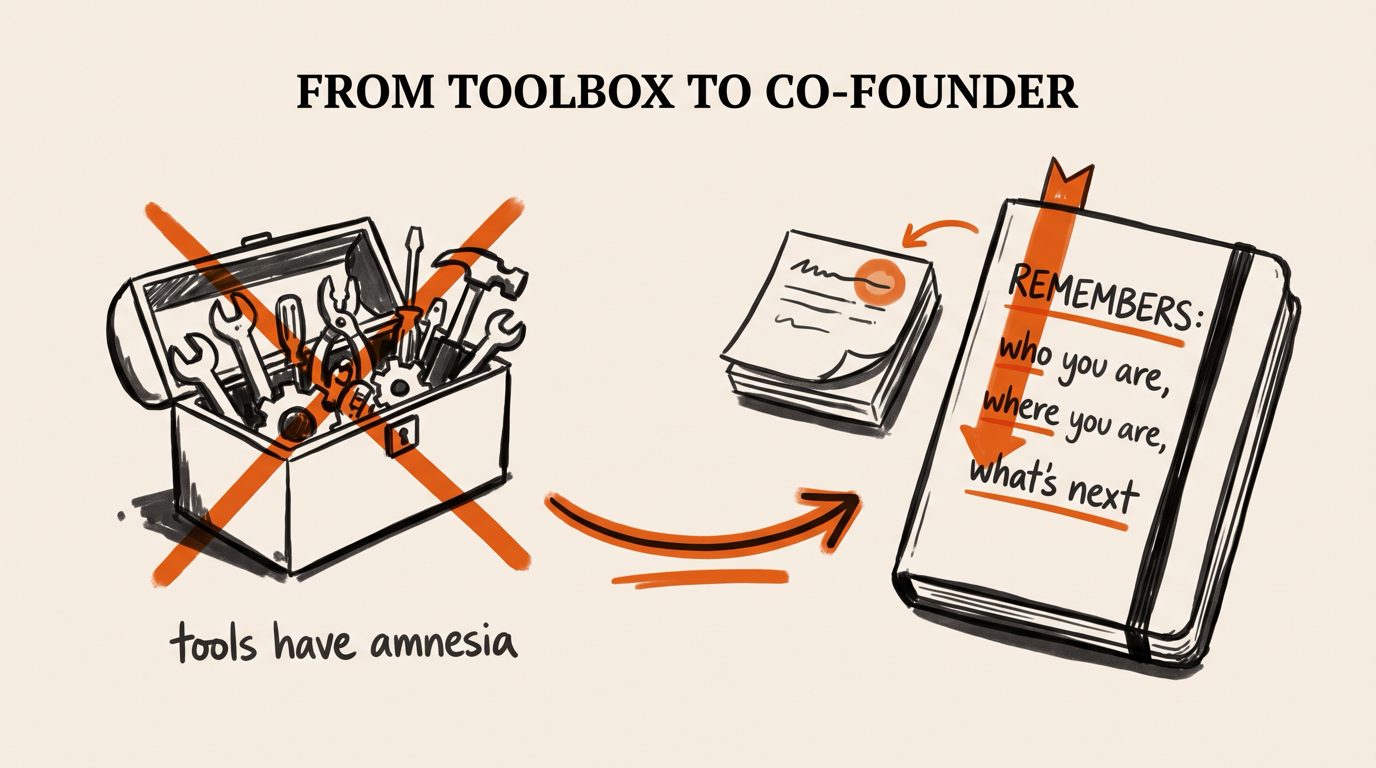
My Plan A for this product was a collection of discrete workflow tools: run a stress test here, generate a pitch there. I had already buried two of my three summer prototypes (weeks of work, discarded) for trying to script the founder’s journey into fixed pipelines, and yet I was still, in my head, selling founders a toolbox. The interviews said the toolbox was the wrong shape. Nobody asked for one more tool to manage. They were drowning in tools with amnesia.
So LEANSpark changed shape: from an AI coaching toolbox to an AI co-founder that remembers who you are, where you are in your journey, and what your next right action should be, with every session opening on a summary of where you left off instead of a blank prompt. Memory is the hardest part of that promise and it is only partially built; the pen-and-paper version, meanwhile, has always worked: a founder journal your coach actually reads before each session.
One closing caution from the same interviews: not every use case you discover needs to fit your product. Mapping what happens before and after your slice of the journey is where you find your unique value, and that design work is exactly where we went next.
Founders do not struggle with a shortage of things to do. They struggle with focus. Next episode: how these insights became the actual MVP, and why we designed for wants over needs.
-Ash
P.S. If you want the video version with the interview breakdowns, it is in episode 5 of Building LEANSpark.