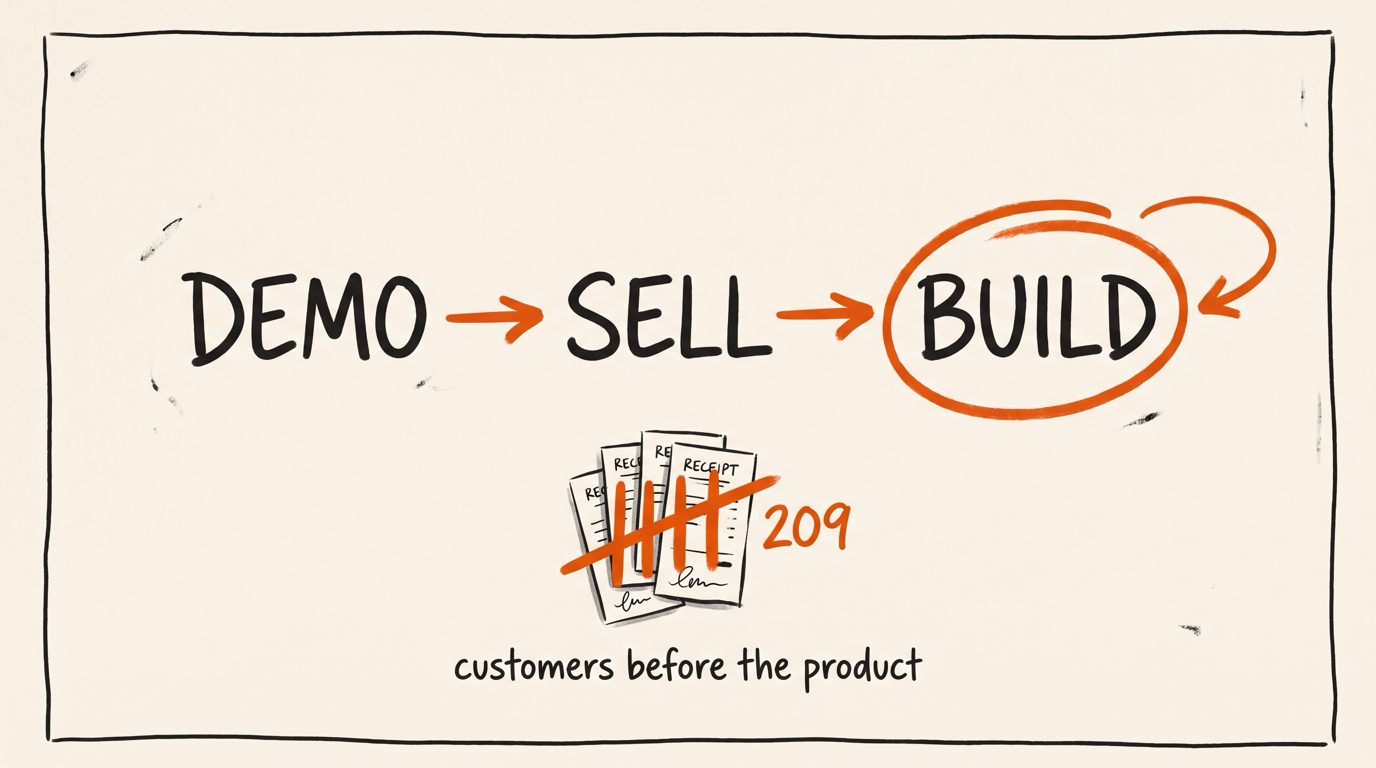
How I Signed 209 Customers Before Building the Product
The Demo-Sell-Build campaign from the inside: a concierge MVP, a demo of software that did not exist yet, and 40 days from zero to 209 customers.

First published as episode 4 of the Building LEANSpark series. This is the notebook version; the episode has the video.
Last time I shared the 90-day plan and an early scoreboard. This episode is the campaign behind those numbers. It is also the messy middle: the part where you are not 100% sure things will work, you are building the product while talking to customers, and you are finding out whether founders will pay at all.
It was mid-September. Two weeks of intensive prototyping had convinced me an agentic AI co-founder was technically possible. Three massive unknowns remained: Do founders actually want this? Will they pay for it? And can we build enough of it to launch in 2 to 3 months?
I became the product
My secret weapon was the Concierge MVP, a pattern Eric Ries popularized in The Lean Startup: instead of building the product first, you become the product. I offered free business model reviews where founders could submit their Lean Canvas and receive a personalized diagnostic.
The real value was not filling my calendar with reviews. It was twofold. First, every review was a learning opportunity. Second, I was incrementally replacing myself with the machine: I ran each canvas through the prototype first, then tweaked it to match how I would actually coach that founder.
I used a give-before-you-get approach. Instead of emailing founders a diagnostic report, I offered to walk them through it on a call. That was the give. At the end, I asked if I could interview them separately about how they were currently validating their idea. That was the get. Those conversations turned out to be some of the most revealing customer research I have done in years. And it kept compounding: every customer who later paid for a canvas assessment was also, quietly, giving me a problem discovery interview. The Concierge MVP is not just a sales tactic. It is a continuous learning engine.
Selling a demo of software that did not exist
When I had enough signal from 10 problem discovery interviews, I kicked off the broader Demo-Sell-Build campaign in October, using the 10x Product Launch playbook I first published in 2011: scale the hockey stick instead of letting it play you. 10 customers first, then 100, then aim for 1,000. Each level surfaces a different riskiest assumption. At 10 you maximize learning. At 100 you start automating. At 1,000 you go self-serve.
The landing page needed a demo. The product was not built yet. This is where founders get confused, so let me say it plainly: you do not need a working product to build a real-looking demo. You need to have designed the product. I used Claude Code to build a demo runner that simulated conversations between a founder and the agent, and the demos on the landing page were screencasts of those simulated exchanges.
Full transparency, then and now: nothing shown was working code at the time. I was 80 to 90% confident we could build it, and that confidence came from the two weeks of prototypes, not from optimism.
When a customer buys a demo, the demo becomes your marketing requirements document.
All you need to deliver is what the customer bought. Nothing more.
The stages
Stage 1 launched October 9th with just 10 spots, handpicked from our most active customers. It filled in 6 days. Stage 2 sold out by October 30th. Through November I stacked an email campaign, a Black Friday bundle, and a referral program, and we crossed 209 customers and roughly $35,000 in revenue. About 40 days, against the 90 I had planned for.
Before those numbers read as a victory lap, here is the honest ledger. LEANSpark, the product all of this sold, exists today as a prototype plus me behind the curtain, and delivering what 209 customers bought is a debt I have knowingly taken on; whatever the build teaches me, I will share it here, misses included. The play itself needs no software at all: a calendar link, a canvas review you do by hand, and the discipline to sell only what you have designed end to end.
The messy middle is where the real learning happens. Not the launch day screenshot, not the revenue graph: the weeks in between, when you are simultaneously seller, builder, and researcher. Next episode: what those disguised problem discovery interviews actually revealed, because one finding changed what we are building.
-Ash
P.S. If you want the video version with the actual demo screencasts and the landing page teardown, it is in episode 4 of Building LEANSpark.