Why I Build for Wants, Not Needs
Features are needs and outcomes are wants, and customers care far more about their wants. How that one distinction shaped an entire MVP.

First published as episode 6 of the Building LEANSpark series. This is the notebook version; the episode has the video.
Last time problem discovery ended with a reframe: founders were drowning in tools with amnesia, not starving for frameworks. This episode is about turning that insight into an MVP, and the single design decision that mattered most.
After weeks of interviews, the picture was clear. Founders were not lacking frameworks or tools. They knew Lean Startup, they knew jobs-to-be-done, some could quote them back to me. The problem was putting it all into practice consistently while paying the crushing context switching tax of startup life.
The broccoli problem
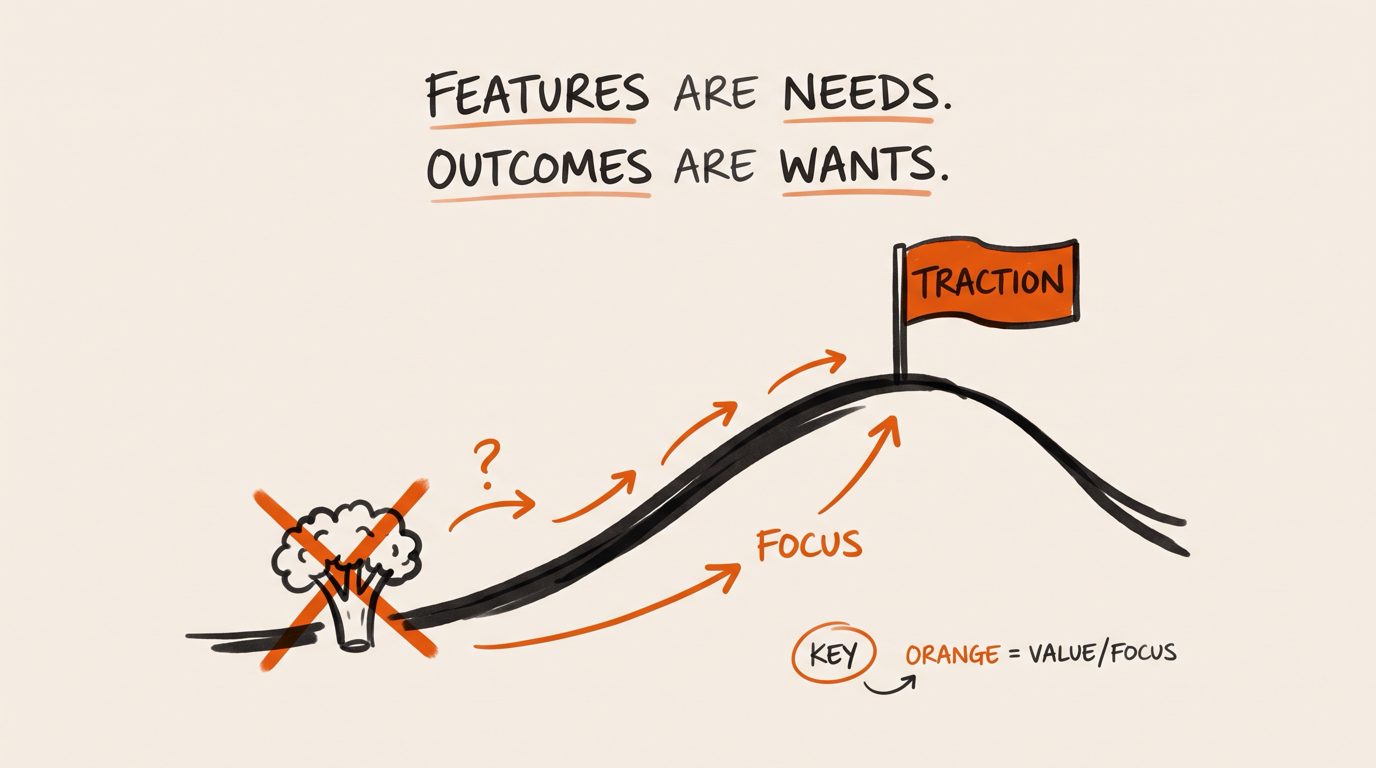
The most important design decision: wants before needs. Originally we had been sketching discrete workflow tools: an elevator pitch generator, a business model assessment, a specific stress test. These are needs. They are the broccoli of startup validation: good for you, and not what gets any founder out of bed in the morning.
Features are needs. Outcomes are wants. Customers care far more about their wants.
What founders actually want is traction. If you have not launched: how do you go from idea to first paying customers? If you have: how do you acquire more? Time-boxing the outcome to 90 days made the promise specific and actionable. Helping founders run 90-day validation cycles became the primary job to be done, in Bob Moesta’s sense of the phrase: the progress the customer is hiring you to make.
Using the Customer Forces model, I drew it as a hill. The desired outcome, traction in 90 days, sits at the summit. To get there, founders must do hard things: create business models, stress-test them, talk to customers, design experiments, run campaigns. Each is a friction point on the path. The secondary jobs became about reducing friction around those hard things, not adding more features. This reframing shaped the landing page directly: a UVP targeting the want (validate faster, build with confidence) and three core features aimed at the top three friction points: learning the framework, stress-testing business models, and running 90-day experiments.
Product/Launch Fit
With the product direction set, we shifted to the short game before Product/Market Fit: Product/Launch Fit. Most founders think launch day is about finishing the MVP and doing a big-bang release. There is much more to it, and most of it is choreography.
We designed the value delivery journey as a Progress Reward Loop: map what a customer can experience in the first 30 seconds, the first few minutes, the first hours, days, and weeks. A doubling progression from first touch to habit formation, and the habit end of that loop borrows from BJ Fogg’s behavior design: make the next action small and make it rewarding.
We worked through pricing models that balance value-based pricing against real AI usage costs. And we planned a batched rollout: 10 customers at high-touch concierge, then 100 in semi-automated cohorts, then 1,000 self-serve, with each batch buying us time to learn, fix issues, and improve before the next wave arrives. Batched rollouts beat big-bang launches for the same reason small experiments beat big ones: you get to be wrong cheaply.
The 100X Founder workshop grew from the same principle: a 13-week cohort-based program guiding teams through a complete 90-day validation cycle, the done-with-you layer on top of the do-it-yourself product.
Where this stands, honestly
LEANSpark is the do-it-yourself product in that sentence, and the honest status is that the 10-customer concierge batch is real while the 100 and 1,000 tiers are still designs on a whiteboard. The wants-over-needs sort requires no software anyway: your interview notes, a highlighter, and one honest question per feature (is this the summit, or is this broccoli?).
That goes for everything else in this episode too. The Progress Reward Loop, the batch gates, the pricing model: all designed, only partially executed as I write this. Whatever comes out of the rollout, I will share it here, numbers included.
Founders do not wake up wanting to run a stress test. They want paying customers. Target the want as the destination, and spend your feature budget removing friction from the path. Next episode: the rollout itself, where these designs meet their first real batches of founders.
-Ash
P.S. If you want the video version with the hill diagram and the landing page walkthrough, it is in episode 6 of Building LEANSpark.