Your Lean Canvas Is a Ladder of Beliefs
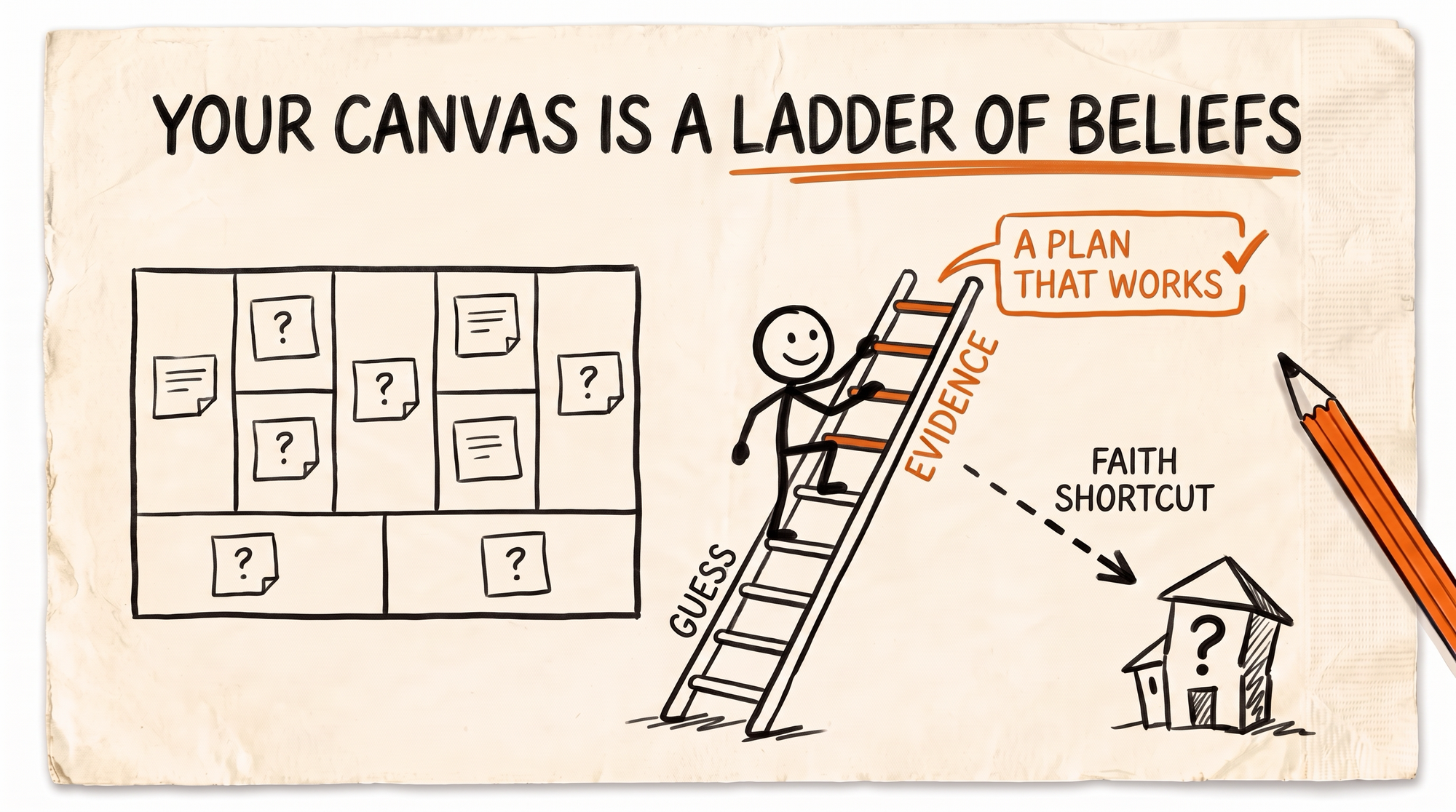
The 20-minute canvas sketch was never meant to be a document. It's a ladder of beliefs. Third post in Running Lean: AI Edition.

Last week I wrote that understanding principles was never the hard part. Putting them into practice every week is.
Practice Trumps Theory.
This week I’m taking apart the very first step in the Running Lean playbook: Document Your Plan A and where it fails.
The canvas was never the point
When I created Lean Canvas, the goal was to get your idea out of your head, where it’s beautiful but vague, and onto a single page that forces clarity and specificity. Because:
You can’t systematically test a vague idea.
That part worked. Millions of founders went on to sketch their ideas on canvases.
What didn’t work was what happened next. Most canvases get sketched once and filed away, while the evidence moves under them.
The canvas was never meant to be a static business plan. It’s a living collection of key beliefs where every item starts out as a guess and has to climb a ladder of evidence.
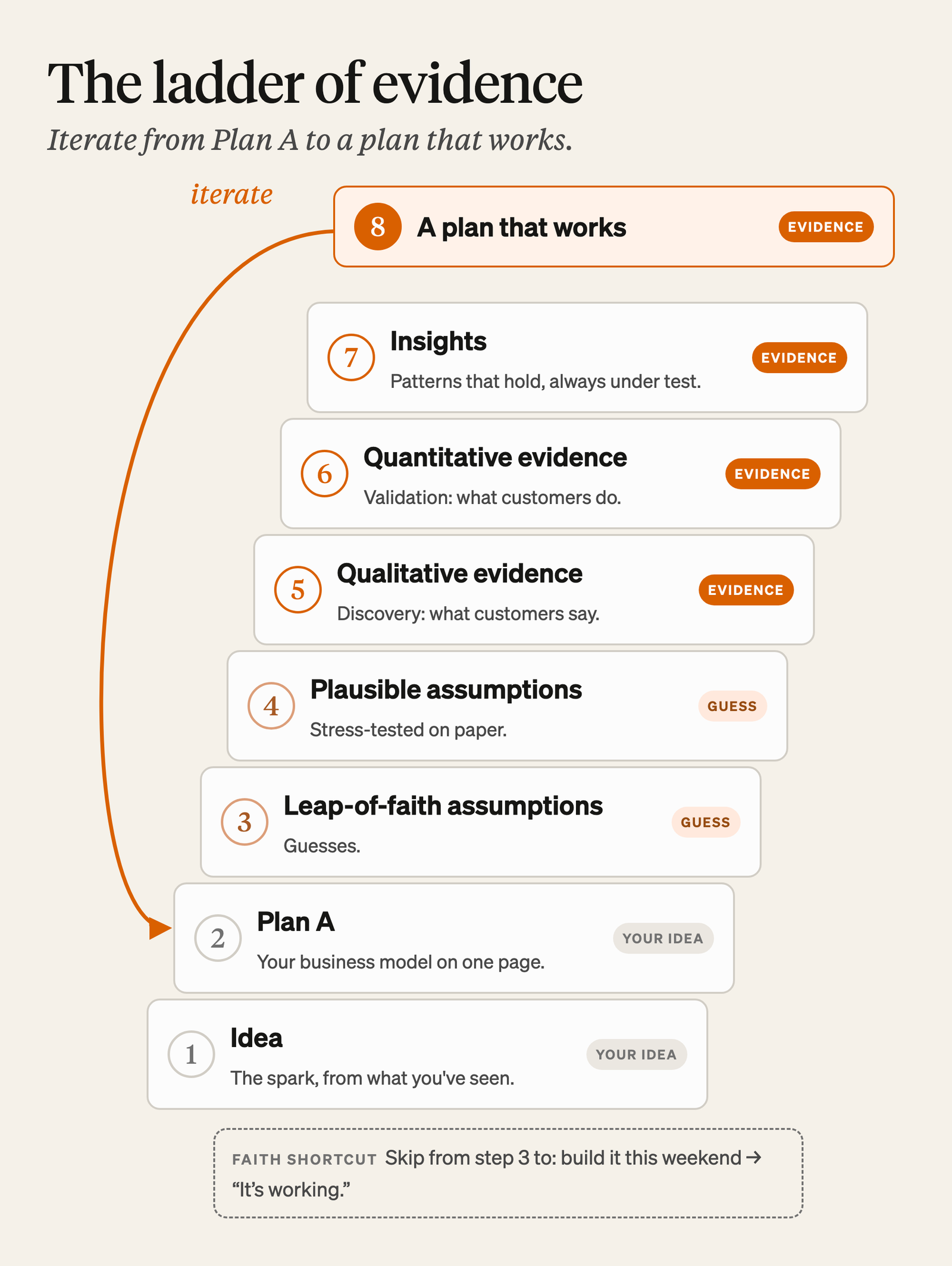
- Idea. The spark, from experience and observations.
- Plan A. Your business model on one page.
- Leap-of-faith assumptions. Guesses. Most of your canvas lives here on day one, and that’s fine.
- Plausible assumptions. It survived a thought experiment. You stress-tested it on paper (clarity, desirability, viability, feasibility) and it held up. Thinking can take a belief this far, and no further.
- Qualitative evidence (Discovery). Customers told you so. Interviews, conversations, replies.
- Quantitative evidence (Validation). Customers did something. They showed up, used it, came back, paid. (If those sound familiar, they’re the steps of the Customer Factory.)
- Insights. Patterns that hold, always under test.
- A plan that works. They paid at the level your business model needs to work.
When you skip from idea or even raw leap-of-faith assumptions straight to building, you’re on the faith shortcut: build it in a weekend, and hope it works.
Why this matters even more now
In 2011, if your canvas was out of date, you lost some time. In 2026, you can build the wrong product in a weekend. That would be fine if you could find out whether it works over the next few weekends. But when you build something nobody wants, there are no users to learn from, and we go all in on faith mode.
Faith-mode: If I keep building, I will crack this.
This is why the evidence ladder is even more important in the AI era. My thesis is that AI also makes it easier to build the ladder.
Maintaining this ladder by hand is exactly the process step founders skip. After every interview, you’d have to work out which beliefs it touched, whether it supported or refuted them, and what moved. After every experiment, the same. And every few weeks, you’d go looking for the beliefs nobody has tested in a while.
That’s not creative work. It’s disciplined process work. The kind we can make AI be good at. A nice parallel here is how AI coding agents have taken over source code versioning and pull requests. The same is true with beliefs mapping as long as it’s checked against evidence, not vibes. And the work happens automatically.
I’ve been experimenting with this exact approach in a new product, LEANSpark.
Here’s how it works.
1. Document your Plan A in under 2 minutes
My old advice was to timebox your first canvas to under 20 minutes, so you don’t overthink your way into analysis paralysis.
Perfection isn’t the goal, but taking a quick snapshot of your idea.
AI can now even let you do this 10x faster. Describe your idea in a paragraph or two. Or better yet, point it at an existing landing page, slide deck, or strategy doc. You’ll have a pretty decent-looking canvas in under 2 minutes.
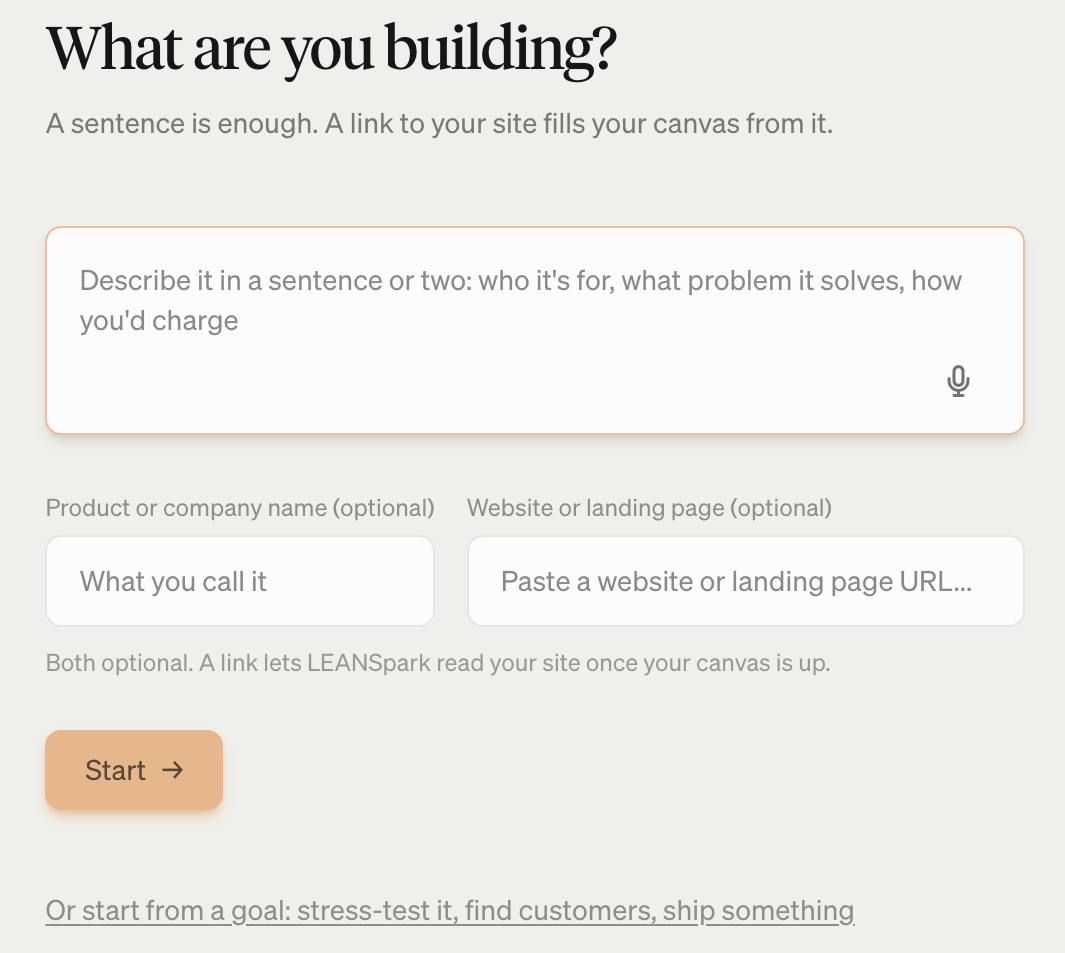
The real win isn’t saving time. It’s never having to face a blank page.
2. Find where you are on the evidence ladder
Everything on your canvas starts as a guess or a leap-of-faith assumption.
Next, you tell the AI where you actually are. Give it more context, like your current metrics, customer commitments and conversations, and it scores each assumption on the evidence ladder.
You can see this on the canvas by toggling on the Evidence layer:
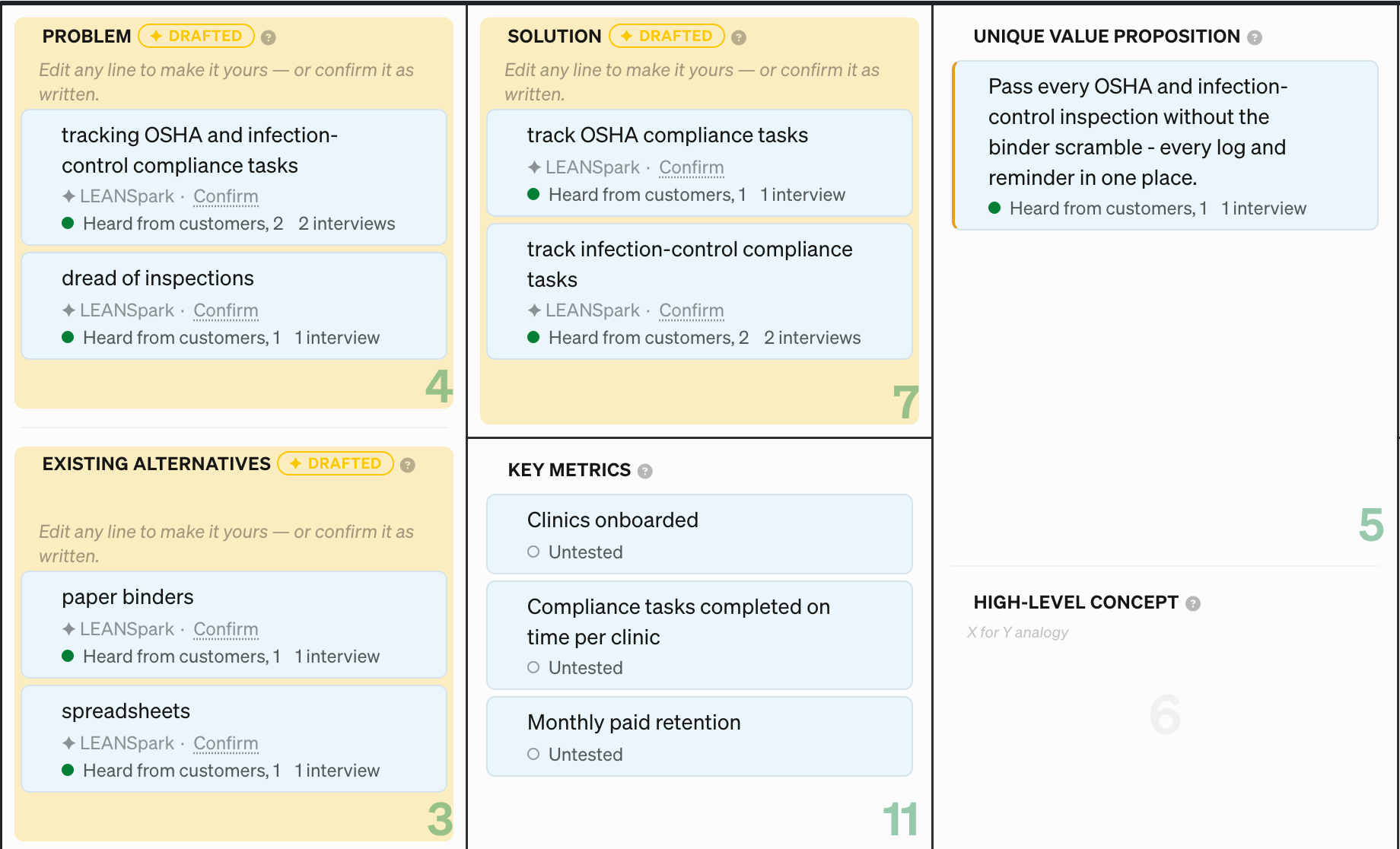
Click the image to see the full canvas.
Each line shows where it stands on the ladder: Untested, Heard from customers, and on up through Reached them, Tried it, They came back and Paid, to Proven.
Trust and reliability are hard to get from today’s LLMs and generic AI tools. That’s why I picked them as our NorthStar value metric for LEANSpark.
If you can’t trust the AI to cite evidence truthfully or not to flip-flop across turns, it becomes a yes-machine. One literally designed and optimized to agree with you, and to feed your inner Innovator’s Bias.
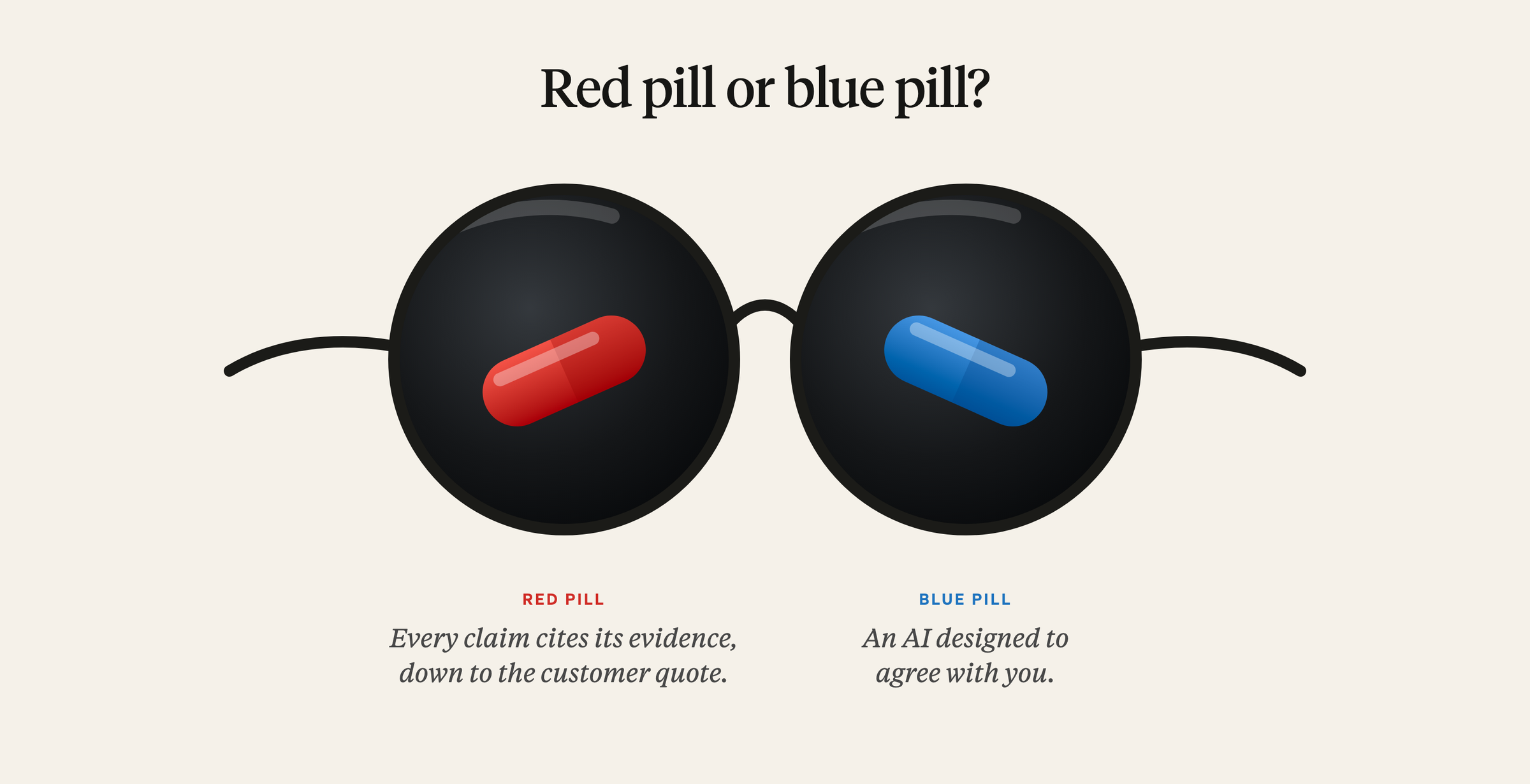
So in LEANSpark, every evidence claim comes with citation links that point to the evidence itself, down to the customer quote. You have to be able to audit every one.
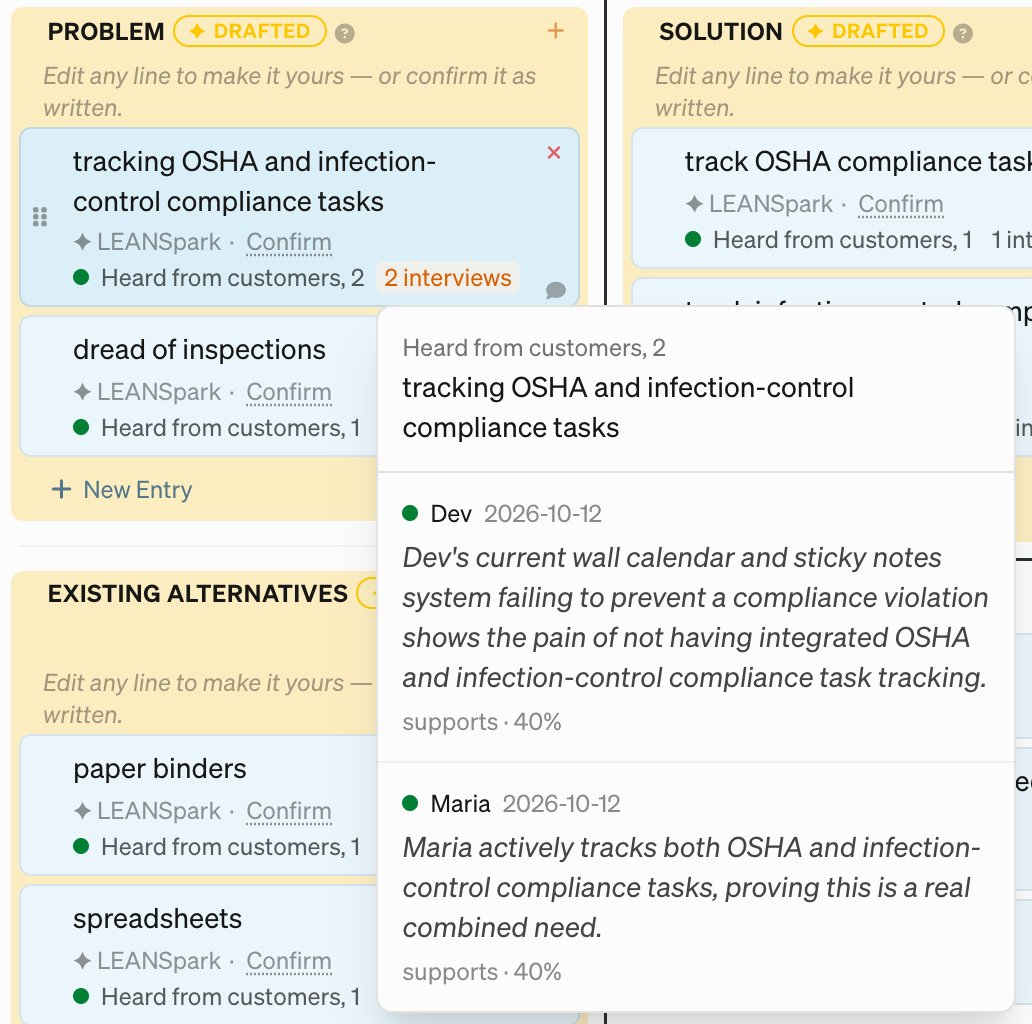
Sidebar: I blogged about this assumption-to-evidence tracking process over a decade ago, and even tried building an early prototype. It worked in theory back then too, but it was too much process overhead for a founder to keep up. Times have changed, with assisted intelligence now at our fingertips.
3. Keep the evidence coming
Remember, the problem was never the first canvas sketch, or even the once-off baselining of your assumptions and risks. It was doing it continuously.
For this to really work, the AI has to keep taking in evidence, whether that’s metrics, customer conversations, or even your own opinions (new assumptions), and update the ladder in real time.
I used to be quite worked up about designing and running good experiments. There’s still a place for that. But some of the most valuable activities, like customer conversations, don’t make great deliberate experiments.
Sure, you could run a deliberate two-week problem discovery sprint where you’ll learn a ton. But some of your best insights might come nine weeks later, from a conversation you never planned. Experiment design is another step that works in theory but fails in practice, because of all the process friction.
I’ll tackle that in a future post. For now, the key message is to collect and process every worthwhile piece of evidence you come across… because:
Breakthrough ideas can come from anywhere.
As the evidence rolls in, the AI clusters it and looks for patterns, which is another thing AI does much better than humans. Then it makes suggestions, not decisions, about what to test next. That’s how you move up the ladder from a Plan A to a plan that works.
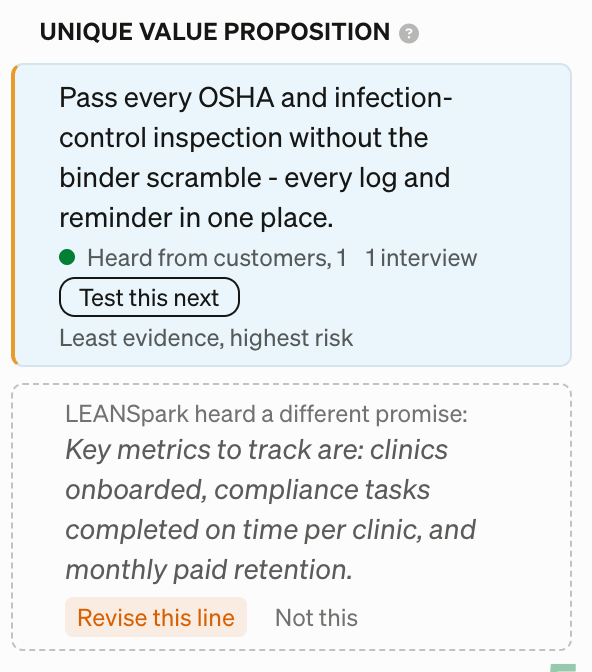
The payoff: evidence-based decisions
Good evidence-based decisions have always been the payoff, and that’s the promise I’m aiming for here. I don’t believe it comes from some all-knowing Oracle LLM. They come from many small learnings, compounded across insights, experiments, and decisions.
In the original Running Lean book, finding your riskiest assumption was a judgment call made over a canvas. Experience helped, and gut feel did a lot of the work. But it was still guessing, and that bothered me.
So, I closed this loop in the sequel book: Scaling Lean, where I introduced a Systems Thinking approach to uncovering constraints/bottlenecks and risks using The Theory of Constraints applied to business models.
All risks are not created equal. They vary by stage.
LEANSpark follows the same principle, prioritizing your riskiest assumptions not by some guessed order but by where your metrics point as the bottleneck or constraint.
What’s next
Step 5 on the ladder is qualitative evidence, and its main source is customer interviews. In the next post, I’ll finally share what I promised two posts ago: the interview analysis results, and which of my 2011 interviewing rules AI broke first.