Why Simple Isn't Easy
When building stops being the bottleneck, discipline becomes it. The method was never the hard part; running it every week is. Second post in Running Lean: AI Edition.

In my last post, I promised the interview-analysis results, including which of my 2011 rules broke first. They’re coming. But before the data, I owe you the reason we’re running these experiments at all.
This is the second post in Running Lean: AI Edition. Same principles, new tactics, re-tested one at a time on a live product.
The question that started this series was simple: when AI can build your prototype in a weekend, what becomes the bottleneck?
My answer surprised me a little. It isn’t knowledge. It isn’t tools. It’s discipline.
Simple doesn’t mean easy
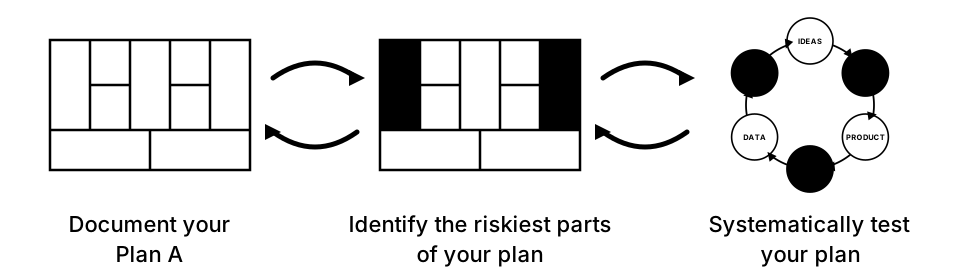
The core of Running Lean fits on an index card.
- Document your Plan A.
- Identify what’s riskiest.
- Systematically test and iterate to a plan that works.
None of that is hard to understand.
I’ve watched thousands of founders nod along to it in workshops. And, come Monday, I’ve watched most of them revert back to business as usual.
Not because they disagreed. But because simple principles collide with their practice.
We want to build. We want to be right. We want to skip the uncomfortable conversation and get to the part where we’re making something.
That’s why I’ve always maintained that the early-stage game is about mindsets over skillsets. You can learn customer interviewing skills in an afternoon. Getting outside the building takes longer… and learning to want to be proven wrong takes even longer.
I wrote about the two founder archetypes I kept meeting, the artist and the innovator. The artist builds what they love and hopes the world agrees. The innovator builds what the world will pay for and stays in love with the problem rather than the solution.
Most founders start as artists. When they realize the art doesn’t usually sell itself, many turn into innovators. The method exists to turn them into innovators without killing the art, faster.
If you can’t describe it as a process
There’s a line from W. Edwards Deming I took to heart early on:
“If you can’t describe what you are doing as a process, you don’t know what you’re doing.”
I spent many years searching for a sequence of meta-principles and tactical steps to turn aimless wandering into a systematic process – one that works across any product or business model. And then many more years testing and refining these steps across many teams.
The result was
- a set of mental models for capturing key beliefs, metrics, and insights,
- a systems-oriented way for identifying (versus simply guessing) at what’s riskiest, and
- a rapid experimentation framework built on 90-day goals, cycles, and sprints.
I ended up with a process you can actually describe and practice – which brings me to the next problem.
The discipline gap
A described process still has to be run. Every day, week, and month.
That’s the part founders aren’t disciplined about. I don’t mean that as a criticism; I am the same.
I am great at modeling, prioritizing, and designing experiments… but running those experiments over several weeks requires
- defining falsifiable hypotheses before the test instead of after,
- analyzing interviews instead of just having them,
- finding patterns, updating models, and making hard pivot, persevere, or pause decisions.
All of it takes process and discipline, and it competes with the fun of building products.
Here’s what the gap looks like in practice:
- A Lean business model Canvas gets sketched once and never touched again, even as the evidence moves under it.
- Interviews happen, but the notes sit in a doc nobody re-reads.
- Experiments start without a target, so they can’t fail or teach anything.
- Ninety days go by, and nobody can say what was learned. So we keep spinning until resources run out.
The principles were never the bottleneck. Keeping the books on your own learning was.
Coaching closed some of this gap, but it doesn’t scale.
The one thing I’ve seen reliably close that gap is a good coach. Someone who remembers what you said last week, asks what you learned, and won’t let you skip the hard conversation. External accountability.
It works. It’s also expensive, and the founders who need it most — first-time, early-stage, pre-revenue — are the ones least able to pay for it. One coach can carry only a handful of teams. So for years, the method scaled through books, workshops, bootcamps, and the discipline didn’t scale at all.
Could AI help?
The obvious answer in 2026 is “use AI.” And I tried that. I went all in last September (2025) to explore this question.
First the challenges:
- AI is trained (with RLHF) to impress and agree with humans. But early-stage founders need more red-pill than blue-pill.
- AI can hold 3 textbooks in context and still fabricate fiction over facts.
- AI removes the build bottleneck, making it ever more seductive to build it all first. You can now build 3 products in parallel that no one wants.
Where my head went wasn’t for generative uses of AI but predictive ones.
Could we let AI hold the process?
One that reliably remembers your business model, your evidence, what you tried last, and knows where you are on the map.
One that surfaces the right questions (not answers) and how to get to the right answers.
One that uses a models + evidence ladder for wayfinding, not just vibes.
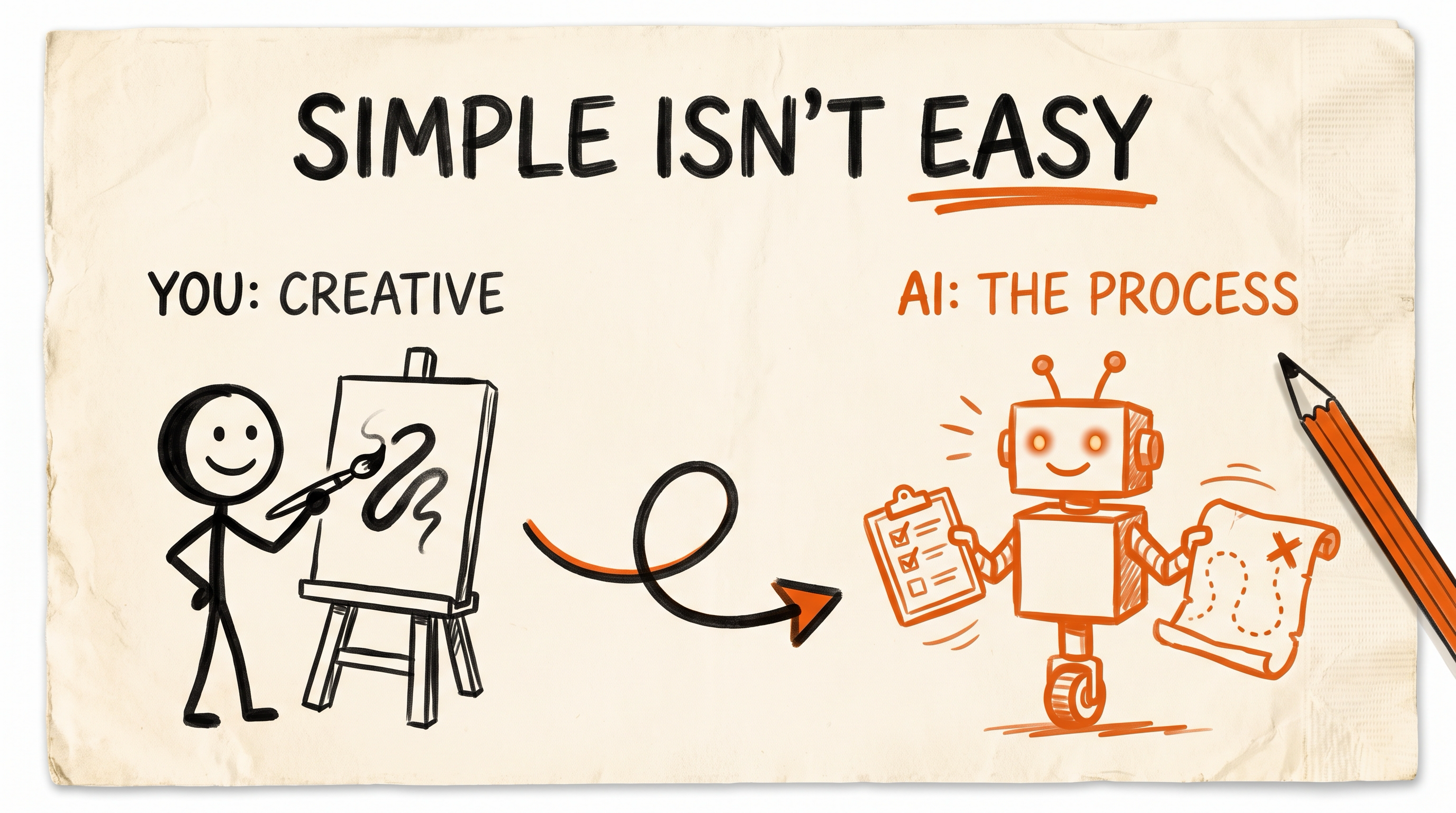
You focus on being creative. Let AI manage the process.
- The founder does the creative and human work. Talking to customers with empathy. Pitching the offer with passion. Deciding what to build with judgment.
- AI does the bookkeeping. It turns your idea into key beliefs, tracks the evidence for each one, picks the next step from where you actually are, and keeps your 90-day plan current without asking you to fill out a TPS report.
Simple. But simple isn’t easy, and that’s what the next series of posts will explore in more depth.
What’s next
Next post, I’ll take the very first step apart: how a 20-minute Lean Canvas sketch changes in the AI era to become a list of beliefs, and how each belief climbs a ladder of evidence, from “untested” to “validated”, as you go.