Yes, makes sense.
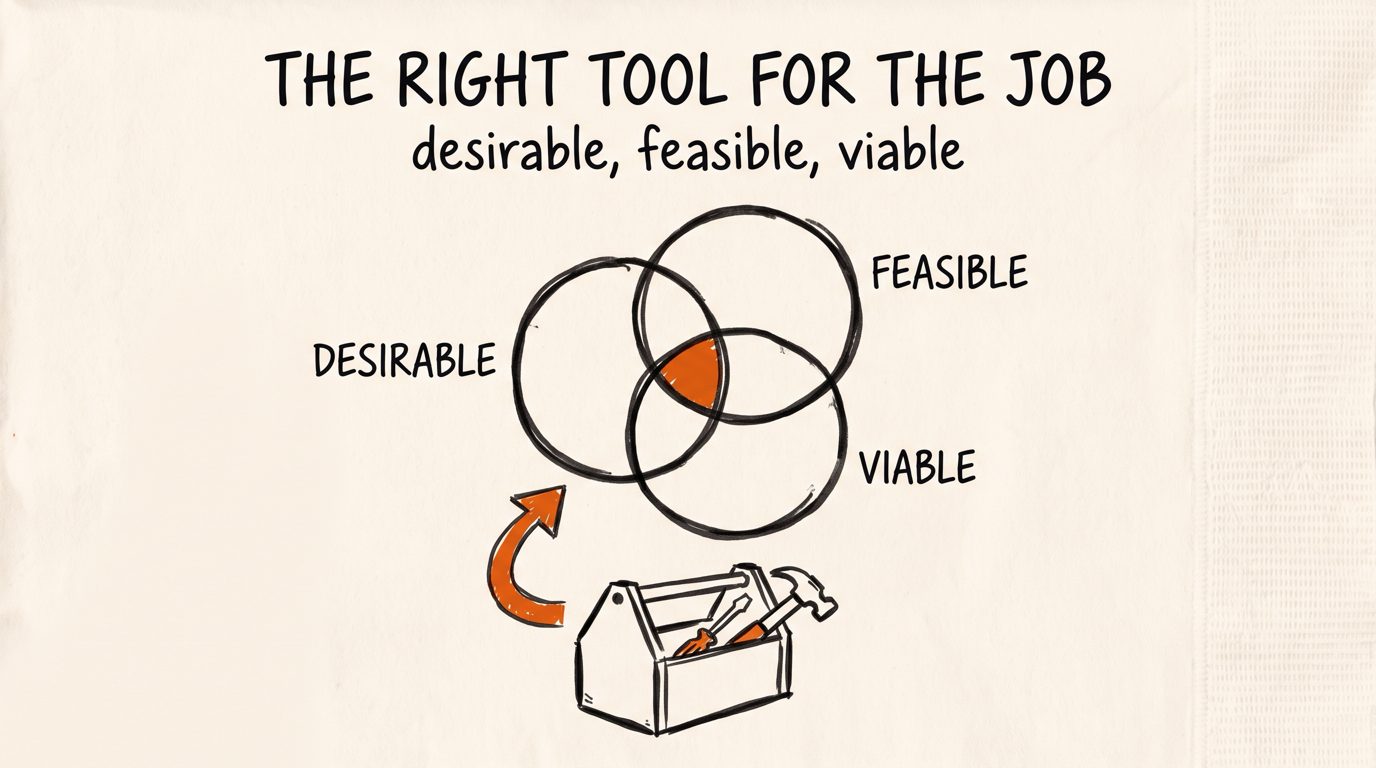
The three circles are definitely generic and broad which isn’t necessarily a bad thing. I often use two other lenses:

Yes, makes sense.
The three circles are definitely generic and broad which isn’t necessarily a bad thing. I often use two other lenses:
- categorizing risks into customer risk, technical risks, and market risks, or
- business model jobs into value creation, value delivery, and value capture.
These alternative lenses also align nicely with desirability, feasibility, and viability.
I personally don’t attach scalability or profitability or sustainability into these basic lenses because those attributes are time/maturity/value based. In other words, most businesses don’t start out scalable, or profitable, or sustainable (or need to even get there at all). But all businesses should address desirability/feasibility/viability at the most basic level from day 1
- do customers want this?
- can we build this?
- can we get paid?
Over time those concerns can/do morph into those other concerns.
As to the assignment of specific aspects of these frameworks to specific circles, that’s a function of how we (LEANSTACK) use specific super-powers of each framework.
Your mileage could vary.
Yes, some do overlap, but the idea of using a framework of frameworks is to curate the best tool for the specific job. Can a hammer fit in place of a screwdriver? Probably not a smart idea. But can a power drill help be more effective than a screwdriver? Yes, for specific types of jobs.
Customer development, for instance, describes the 4 steps to the epiphany, and the lean startup principles span all 3 circles. But we (again at LEANSTACK) use CD just for customer discovery and marry it with other techniques from other frameworks (like JTBD).
With regards to Lean Startup, lots of people simply boil it down to MVP, experiments (Build/Measure/Learn), and innovation accounting (metrics)… that’s not enough. Lean Startup’s super-power is hypotheses validation, but there’s a gap of hypotheses generation that’s not adequately addressed. In other words, where do good ideas come from?
Why business modeling tools for viability? Because they help identify the riskiest metrics assumptions and more importantly help define what viability even means in the first place with respect to one’s specific business model. These models help answer questions like:
- What is product/market fit, how do we know when we get there?
- How many customers should we talk to? How do we know we are done?
- Is the business model really working? How do we measure traction?