The Just Start Manifesto: AI Edition
AI made building free. That is worse than it sounds. Why you still don’t need permission to start, rewritten for the age of AI and the Founder Economy.

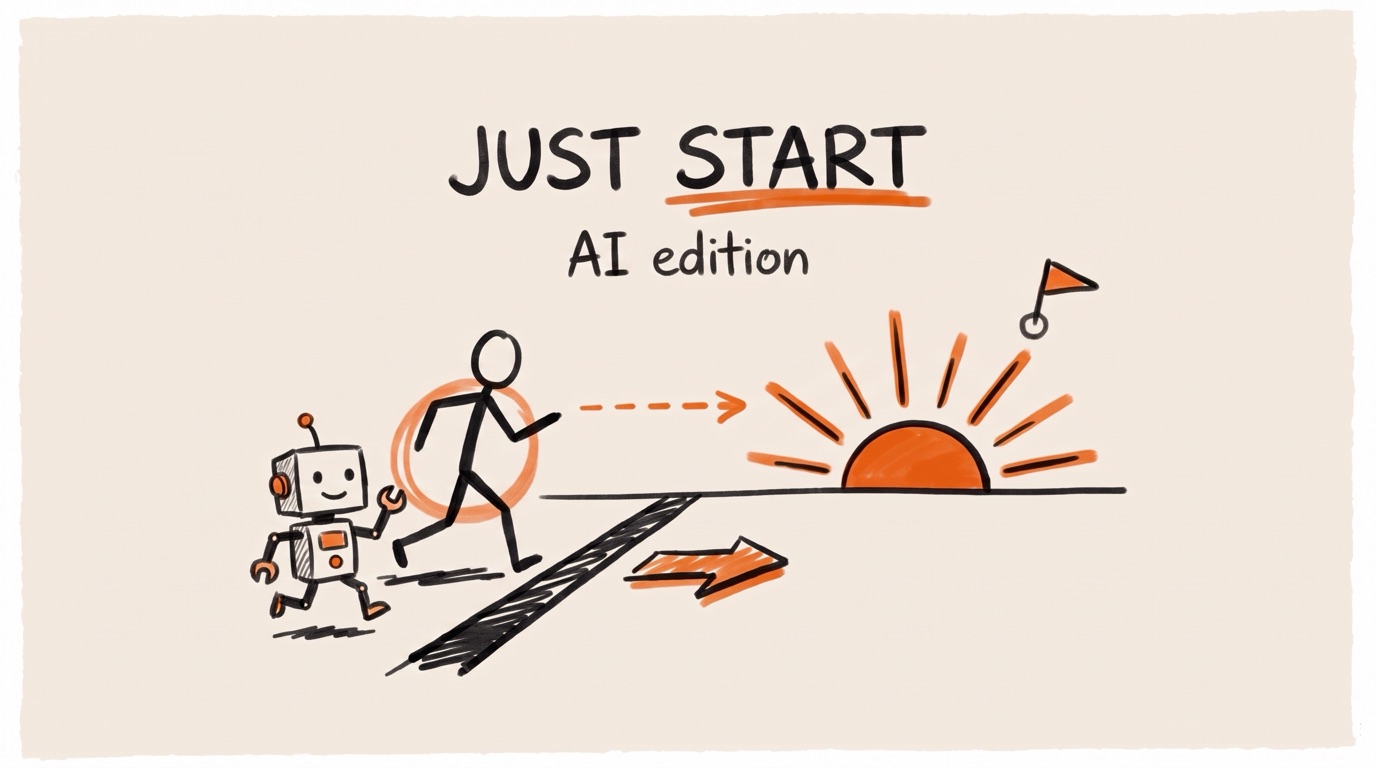
I revise this manifesto every year. This edition rewrites it for a world where AI made building almost free.
1. Entrepreneurs Are Everywhere
While we may look different and speak different languages, the world is flatter than it’s ever been. We have been living through a global entrepreneurial renaissance, witnessed in the worldwide explosion of entrepreneurial programs, startup accelerators, and corporate innovation incubators over the last decade.
We all want the same things, fear the same things, and make the same starting mistakes.
Then we hit a wormhole. AI collapsed the distance between an idea and a working product from months to a weekend. Ten years of change now happens in one.
2. Welcome to the Founder Economy
We are entering a new era. The Gig Economy gave people flexibility. The Creator Economy gave people leverage. The Founder Economy gives people ownership: not of an audience, but of a business model.
The Creator Economy turned audiences into income. The Founder Economy turns domain expertise into companies.
3. The Persona of the Garage Entrepreneur Has Changed
Entrepreneurs are no longer just two guys in a garage in Silicon Valley.
Many of them are still sitting at their desks.
I call them Latent Founders: the product managers, engineers, ops leaders, and consultants with years of domain expertise who’ve been watching unsolved problems in their industries and thinking, “I could build that.”
They couldn’t, until now.
4. The Minimum Viable Founding Team Is Shrinking Toward One
Starting a company used to require a technical co-founder, capital, and a long runway. AI eliminated the first. Validating before you build eliminates the other two. You don’t need runway. You need evenings and weekends.
And it isn’t just Latent Founders. AI turned anyone with an idea and a laptop into a builder:
- Students
More students are seeking out entrepreneurial education and experiences while in college (and even high school). With AI, a class project can become a working product. - Intrapreneurs
The pace of disruptive innovation keeps accelerating. Even previous disruptors are getting disrupted by newcomers. Large companies have to innovate or be disrupted, and AI puts a builder inside every team.
5. There is No Better Time to Start
For the first time in history, we all, more or less, have access to the same tools, knowledge, and resources. It has never been cheaper or faster to launch a new business, and there is no better time than the present to start.
This represents an incredible opportunity for all of us.
But there is a dark cloud in all of this.
6. Most Products Still Fail
While we are building more products than ever before, the sad reality is that the success rate of these products hasn’t changed much. The odds are still heavily stacked against starting a new business and most of these products unfortunately still fail.
And that’s a real problem.
We pour a lot of our time, money, and effort into these products. For a first-time entrepreneur, these failures can be a real setback, emotionally and financially.
7. A Dozen Reasons Why Products Fail
Here are twelve reasons we commonly attribute to failed ideas:
- No money
- Poor team
- Poor product
- Bad timing
- No customers
- Competition
- Lack of focus
- Lack of passion
- Bad location
- Not profitable
- Burn out
- Legal issues
8. The Number One Reason Why Products Fail
At the heart of all these reasons is one core reason:
We simply build something nobody wants.
All the others are secondary manifestations or rationalizations of this brutal reality.
Why does this happen?
I attribute the entrepreneur’s singular passion for their solution as the top contributor to this failure. This is the Innovator’s Bias that causes us to fall in love with our solution and makes “bringing our baby to life” our sole mission.
That bias pushes us to build first. And a build-first approach is backwards, because you can’t brute-force a solution without a pre-existing problem.
I call this the Build-First Trap: building out a product before engaging customers. AI didn’t create the trap. It made the trap effortless to fall into.
Build it in a weekend, and hope it works.
9. The Number Two Reason Why Products Fail
Failing at something requires starting.
The number two reason why products fail is that they never even get started. We spend too much time analyzing, or planning, or making excuses for not starting — we wait to first write a business plan, or find investors, or find a co-founder who can code. You don’t need any of those to start anymore.
10. You Don’t Need Permission to Start
The world has changed. Going back just a decade, starting up was expensive. Getting software licenses to build your product, or office space to meet with your team, required capital investment. Today, all these things are free.
Then AI made the building free too.
Cost was never the obstacle. It was the guardrail.
Expensive was slow, and slow was the only thing that ever made us stop and ask whether we should. Take the cost away and nothing asks. You can build the wrong thing in a weekend now, and another one the weekend after. The Build-First Trap can now spring every weekend.
Here is what that changes, and it is worse than it sounds. Running out of money used to end a bad idea. It was brutal, it was honest, and it arrived on a date. When building is free, the wall never arrives. Nothing stops you. You can spend four years on something nobody wants and never once be told.
AI gives you 10x the ability to build.
It gives you 0x the clarity about what to build.
Speed without validation is just efficient failure.
The question today isn’t:
“Can we build this?”
But,
“Should we build this?”
That was always the better question. Now it is the only one left. You don’t need lots of money, people, or time to answer it.
11. The Scarce Resource Is Problem Clarity
If building is no longer the bottleneck, what is? Problem clarity.
Who has the problem? How badly? Will they pay you to fix it? These questions can’t be prompt-engineered. They require domain expertise and customer conversations, which is exactly what Latent Founders already have.
Here’s how…
12. No Plan Is Not an Effective Strategy
Few founders write business plans anymore, and that’s a good thing. Business plans took too long to write and nobody read them anyway. When you’re operating under conditions of extreme uncertainty, a heavyweight static plan is stale before it’s finished.
But most founders didn’t replace the business plan with something better. They replaced it with no plan: open a prompt, start building, and figure out the business later. That’s the Build-First Trap with better tools.
No plan isn’t freedom. It just makes your assumptions invisible.
You still need a plan, just a lightweight, dynamic one. Create a business model instead. It takes 20 minutes versus 20 days. People can’t help but read it and share what they think. And it gives you something to test.
Not a business plan. Not no plan. A business model you can test.
13. Take Stock of Your Key Beliefs
Deconstruct your idea into a set of key beliefs using a 1-page Lean Canvas.
Rank your beliefs into three buckets:
- leap of faith,
- anecdotal observation,
- evidence-based.
Make a commitment to get all your beliefs into the third bucket starting with your riskiest assumptions.
The Build-First Trap is jumping from the first bucket straight to building. AI makes that jump feel like progress.
14. Take Stock of Your Key Metrics
If you don’t know where you’re going, any road will get you there.
- Unknown
Ballpark your desired destination before you start. Don’t try to estimate your idea’s maximum upside potential. This is hard (if not impossible) to see at this stage. Instead, estimate your minimum success criteria. What is the smallest outcome in 3 years that would deem your project a success?
15. Take Stock of Your Key Insights
Creating something new requires a new perspective.
It requires seeing the world differently from others. What key insight or point of view are you putting forward?
Don’t worry if your key beliefs, key metrics, and key insights are still on shaky ground. Creating something new isn’t easy.
16. Don’t Start With an MVP
Most first products miss the mark completely. Taking a build-first approach worked when there was less competition. But the world is different today.
Customers today have lots of choices. When they encounter your half-baked product, they don’t turn into beta-testers. They leave.
So you can build an MVP over a weekend. Well, so can everyone else. When anyone can ship a product by Monday, a working product no longer gets you noticed. An MVP that costs nothing to build costs nothing to copy.
Understanding what your customers want better than anyone else is the new unfair advantage.
You won’t find it in a better MVP. You find it by talking to customers before you build. Skip that, and you’re left guessing and chasing the mythical kill feature. The Build-First Trap ensues.
Cheaper to build is not the same as cheaper to be wrong.
17. Bootstrap Your Way to Early Traction
Investors today don’t fund product development but traction. In a crowded market, investors need to see evidence that people other than your mom and your friends care about your idea. The best evidence is traction or engagement with your idea.
But how do you demonstrate traction without a product?
18. Sell Before You Build
Customers don’t buy working solutions. They buy a promise of better. Sell better, before investing time, money, and effort building a better product.
AI can mock up your demo in an afternoon. Use it to sell, not to ship.
Think Demo-Sell-Build versus Build-Demo-Sell.
When you do this, you end up with a product you know customers will buy versus hope they do.
19. Have Faith in Yourself. Be Ruthless With Your Ideas
One of the major challenges with ideas is that at the outset, all ideas seem amazing. While passion and determination are essential attributes needed to drive a vision to its full potential, left unchecked they can also turn the journey into a faith-based one driven by dogma.
Reasonably smart people can rationalize anything, but entrepreneurs are especially gifted at this.
20. Love the Problem, Not Your Solution
Problems, not solutions, create space for innovation. Customers don’t care about your solution but their goals. Identify the problems or obstacles that get in the way of their goals, and you identify the right solution to build.
Having more passion for your solution than your customer’s problem, is a problem.
21. Focus on Time Versus Timing
You can’t control the timing of your idea but you can control how long you spend on your idea. Unlike money or people which can fluctuate up or down, time only moves in one direction.
Time is your scarcest resource. Spend it wisely.
Time-box the learning, not the building. The power of a deadline is that it comes due — provided, of course, that the world doesn’t come to an end first. Set an appointment with your team to share your results and discuss how you move forward from wherever you end up by the deadline. Set another deadline and go. This is the best way to hold yourself accountable.
22. Value Your Time Correctly
Sweat equity is the most expensive kind of asset. When you risk adjust sweat equity, your effective hourly rate is closer to $1,000/hr.
This means:
- You are investor #1 in your business.
- You can’t just look for a 1x or 2x salary return. You have to think 10x.
- Everyone gets the same 24 hours.
23. Not Acceleration, But Deceleration
AI makes accelerating easy. But optimizing for time does not mean going fast on everything, but rather slowing down to focus on the right thing. Pareto’s 80/20 rule applies here. Your biggest results will come from just a few key actions.
Your job is to prioritize what’s riskiest first and ignore the rest — until it becomes what’s riskiest.
24. Not Faux Validation, But Traction
The number of features, size of your team, or how much money you have in the bank are not the right measures of progress.
There is only one metric that matters — TRACTION.
Traction is the rate at which you capture monetizable value from customers.
AI can now manufacture the appearance of validation: synthetic personas, simulated interviews, generated survey responses, a research deck nobody was ever interviewed for. Faux validation used to take effort. Now it takes a prompt. And faux validation is what makes the Build-First Trap feel safe.
Which is why the rule hardens rather than softens.
Don’t ask people what they think of your idea.
Only customers matter.
Don’t ask customers what they think of your idea.
Measure what they do.
25. Remove Failure from Your Vocabulary
The fail-fast meme is all about embracing failure as par for the course. However, the taboo of failure is so crippling that most people work really hard to avoid, sugar-coat, or run away from failure. This is counter-productive. You need to instead completely remove “failure” from your vocabulary.
AI made experiments cheap too. There is no excuse left for big-bang bets.
- Break your big ideas or strategies into small, fast, additive experiments.
- Use staged rollouts to implement your ideas from small to large scale.
- Double-down on good ideas, and silently discard your bad ideas.
When you do these three things, you aren’t failing, but course-correcting towards a larger goal.
Remember: Be brutal with your ideas but have faith in yourself.
26. It’s Time to Act on Your Big Idea
There is no shortage of problems in the world. As a founder, you are wired differently. You are wired to seek out solutions. All you have to do is channel your attention on the right problem. And you’ll leave the world better off than when you entered it. Isn’t that all that really matters?
If you’ve been sitting at your desk with an idea you can’t shake, redesigning your company’s product in your head during meetings, describing “what I would build” to friends, you’re not an employee with ideas.
You’re a Latent Founder.
Don’t waste this moment. It’s time to dust off the ideas deep in the recess of your mind and take action.
It’s time to reboot, level up, and just start.